


Aortic insufficiency is an incompetence of the aortic valve that causes blood flow during diastole from the aorta to the left ventricle.
Although rheumatic disease is the most common cause of aortic regurgitation worldwide, congenital and degenerative disorders are the main causes in developed countries, with a mean age of diagnosis of 40-60 years. The prevalence of aortic regurgitation of any degree is estimated to be 15-30%, but only 5-10% of these patients present with severe regurgitation, resulting in an overall prevalence of 1-2% of the general population.
Bicuspid aortic valve (BAV) is the most common congenital heart anomaly, with an incidence of 0.5-1.4% of the population. BAV is a clinically relevant entity, not only because of valve-related complications (valve dysfunction, infective endocarditis), but also because of its association with many vascular anomalies such as dilatation, coarctation and aortic dissection.
More than 50% of patients will develop cardiac pathology (valvulopathy and/or aortopathy with surgical indication) during their lifetime. The current prevalence of severe aortic insufficiency in BAV is variable, with a range, depending on the series, between 13-21% and a mean age of presentation of 50-60 years.
Marfan syndrome (MS) is a genetic, hereditary, systemic connective tissue disease. The incidence is 1/5000-10000 live births, being the most frequent of the “rare diseases”. Among the different organs affected, cardiovascular complications have been the main cause of morbidity and mortality in these patients, such as aneurysmal dilatation of the aortic root or other segments of the aorta, which can lead to potentially lethal events, such as acute aortic dissection, aortic rupture and/or aortic insufficiency, which affect the life expectancy of these patients at an early age. It is estimated that 80% of people with MS will have aortic root dilatation in adulthood.
Echocardiography (TTE)
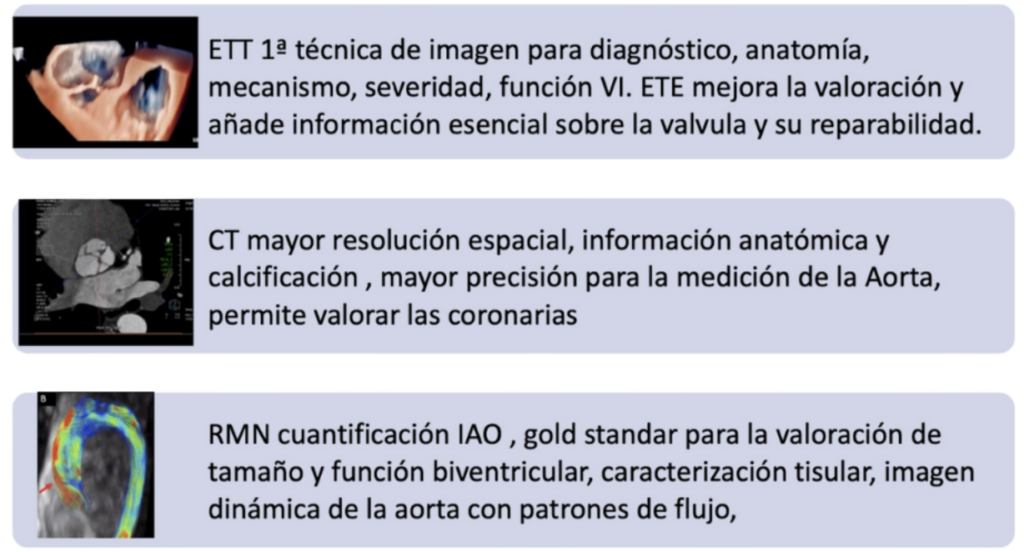
Echocardiography (TTE) is the key technique for diagnosing and quantifying the severity of aortic regurgitation. It is also important for assessing the mechanisms of regurgitation, describing the valve anatomy, and determining the feasibility of valve repair. If valve repair surgery is considered, a transesophageal echocardiogram (TEE) should be performed to better define the mechanism of aortic regurgitation.
Computed tomography (CT)
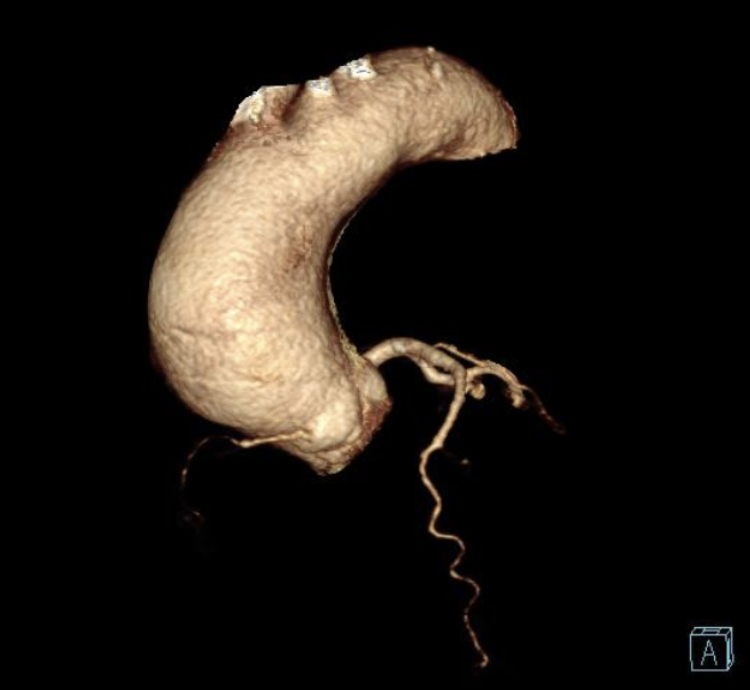
Computed tomography (CT) of the aorta is also indicated for evaluation of the aorta in patients with Marfan syndrome or other connectivopathies or when aortic enlargement is detected on echocardiography, especially in patients with bicuspid aortic valves.
Cardiac magnetic resonance
Cardiac magnetic resonance imaging is recommended in patients with moderate or severe aortic regurgitation with suboptimal echocardiographic studies to assess its severity, as well as left ventricular dilatation and function.
Severe aortic insufficiency tends to follow a slow clinical course. It is typically characterised by a long period in which the patient is usually asymptomatic or reports decreased exercise capacity. When symptoms do appear, the most common is dyspnoea or ‘shortness of breath’. Complications of severe aortic insufficiency include progressive left ventricular dysfunction and dilatation, congestive heart failure, myocardial ischaemia, arrhythmias and sudden death.
In asymptomatic patients with severe aortic insufficiency, 75% survive for 5 years after diagnosis. However, median survival after the onset of heart failure symptomatology is less than 2 years.
In symptomatic patients, the estimated mortality is 10-20%/year, which reinforces the importance of early surgery.
The indication for surgery is established when the patient is symptomatic or when the patient has no symptoms, but there is evidence of left ventricular distress (dilatation and/or dysfunction of the ventricle).

Hospital Universitario Quironsalud Madrid
Calle de Diego Velazquez 1
28223 Pozuelo de Alcarcón
(Madrid)
Teléfono: (+34) 648 764 149
info@aorticrepaircenter.com
Hospital Universitario La Luz Quironsalud
Calle de Maestro Ángel Llorca 8
28003 Madrid
Teléfono: (+34) 648 764 149
info@aorticrepaircenter.com
©2025 Aortic Repair Center Copyright All Right Reserved.
Este sitio utiliza cookies propias y de terceros para mejorar tu experiencia, analizar el tráfico y mostrar publicidad personalizada. Puedes aceptarlas todas, rechazar las no esenciales o configurar tus preferencias.
Imprescindibles para que el sitio funcione. No se pueden desactivar.
| Nombre | Proveedor | Dur. |
|---|---|---|
wordpress_test_cookie |
WordPress | Sesión |
PHPSESSID |
PHP/Servidor | Sesión |
ccd_cookie_consent |
CCD Comunicación | 1 año |
Nos permiten conocer cómo los visitantes usan el sitio.
| Nombre | Proveedor | Dur. |
|---|---|---|
_ga |
Google Analytics | 2 años |
_gid |
Google Analytics | 24 horas |
Permiten mostrar anuncios personalizados.
| Nombre | Proveedor | Dur. |
|---|---|---|
_gcl_au |
Google AdSense | 3 meses |
_gcl_aw |
Google Ads | 90 días |
Guardan preferencias del usuario como idioma o región.
